
Richland Projected Versus Actual Release
A projected release date is a forward-looking sentence field. It reflects the records and credits used by the legal custodian when the calculation is made. An actual release date records an event that has already happened. The two dates answer different questions, and the first does not become proof merely because the calendar reaches it.
A Richland Parish pretrial detainee may have no fixed release date at all. Bond can authorize release while a case remains pending, yet another hold can keep the person confined. A dismissal or release order supplies a legal reason, but the Richland Parish Sheriff’s booking and release event establishes when the jail acted. A transfer also closes one custody phase without returning the person to the community.
For a sentenced person, the projected date may reflect the sentence, jail credit, earned diminution, loss of credit, and the relationship among split or consecutive terms. Diminution means a lawful reduction in time to be served. It is often called good time. A detainer, which is another agency’s request to hold or receive the person, can also change what happens at the end of the first sentence.
Find Richland Parish Projected Dates
The correct route turns on who owns the sentence calculation. Richland Parish operates male and female detention-center units, and a person in either building may be a local detainee or a state-sentenced person housed locally. A building name alone does not identify the legal custodian. Start with the court judgment and the holding agency, then follow the appropriate route.
- Identify whether the person is pretrial, serving a parish sentence, serving a Louisiana DPS&C sentence, or held for another authority.
- For a state sentence, call the DPS&C locator at 225-383-4580 with the DPS&C number, or the name and date of birth.
- For a parish sentence, obtain the Fifth Judicial District judgment, offense date, credit for time served, and sentence structure, then ask the sheriff for the maintained calculation or release record.
- If a date seems wrong, use the facility Records Office for a state-facility resident or the written Administrative Remedy Procedure for a person housed locally.
- After the projected date passes, obtain the actual release or transfer event from the agency that held the person.
DPS&C says its phone locator can provide custodial placement, facility contact information, and the projected release date if applicable. The reviewed source does not establish that LAVNS displays that same field on the public web result. Do not search the VINELink screen for a field Louisiana documents only through the phone locator. The broader Richland Parish release-record path can help confirm the final event.
The official DPS&C inmate-information page documents the locator and sentence-calculation channels:
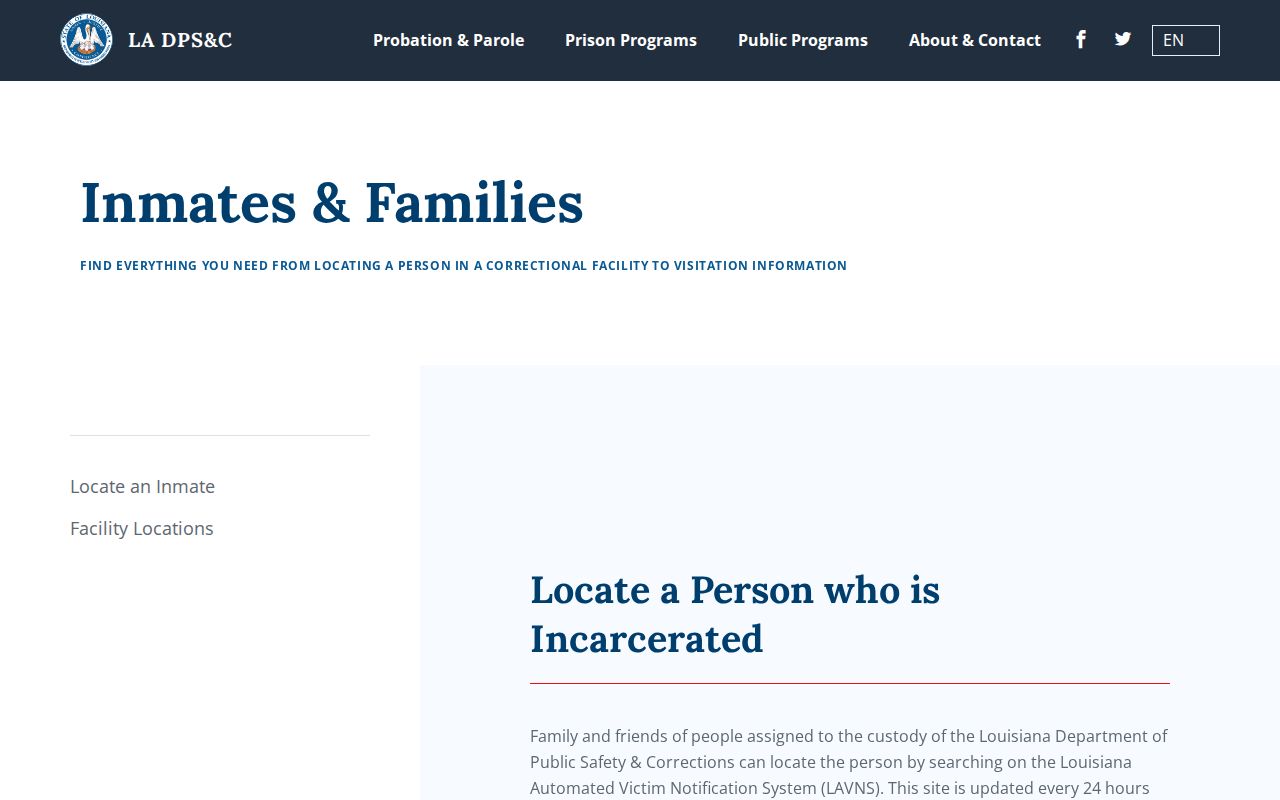
This source is the key distinction between a projected date supplied by phone and a status result supplied through LAVNS.
Note: Newly received sentencing papers may not yet be complete, so the custodian may be unable to supply a final calculation at once.
Older Richland Parish Good Time
Louisiana divides good-time rules by offense date and sentence type. Under R.S. 15:571.3, important older parish-sentence rules apply to eligible people convicted and sentenced without hard labor. The general older parish rate can be thirty days of diminution for thirty days in actual custody. A first crime of violence uses a different rate of three days for seventeen days in actual custody.
The sheriff of the parish of conviction generally determines when that parish good time is earned, unless the statute assigns the role to the superintendent of a qualifying non-sheriff parish or multiparish facility. Older DPS&C felony sentences can use a thirteen-days-for-seven-days-in-actual-custody rate, but exclusions and other offense or history rules can change eligibility. Sex offenses, crimes of violence, repeat histories, life sentences, habitual treatment, and “without benefit” provisions prevent any one formula from being safe.
Offense date matters. R.S. 15:571.3 says an offense committed on or after August 1, 2024 does not earn good time under its older terms except through the newer statute. A news account that states only the sentence length cannot support a sound Richland Parish release-date calculation. The judgment, offense date, classification, jail credit, and sentence structure must be known first.
New Richland Release Date Rules
For an eligible parish or DPS&C felony offense committed on or after August 1, 2024, R.S. 15:571.3.1 generally allows ordinary diminution up to a maximum of 15 percent of the sentence. The law excludes sex offenses and habitual-offender sentences from that ordinary rule. It also treats presentence credit under Article 880 separately and permits forfeiture.
The maximum is the source of the shorthand that an eligible person may serve about 85 percent. That phrase is not a universal truth-in-sentencing rule. It applies only as a careful description of the newer ordinary maximum. Some people are excluded. Other lawful credits may apply, credits may be lost, split or consecutive sentences can alter the timeline, and the offense date controls which law governs.
The official post-August 2024 statute shows the newer maximum and exclusions:
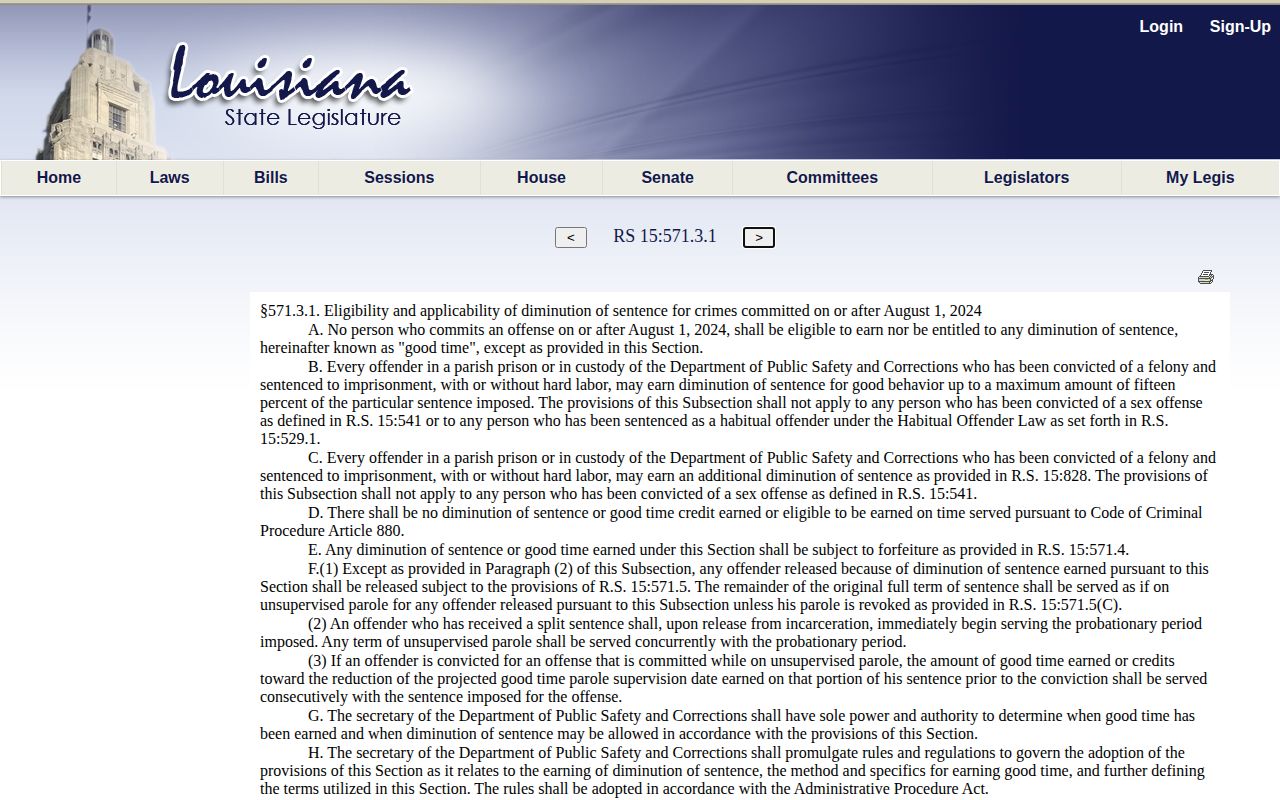
The statutory text is why a Richland Parish computation must begin with the offense date rather than a blanket percentage.
Release on diminution under the newer law generally places the remainder of the term on unsupervised parole. A split sentence begins probation, with any unsupervised parole running at the same time. Physical release therefore does not always mean every part of the sentence is complete.
Richland Release Dates Can Move
A projected date is dynamic. The agency must apply court records and credits as they are received and earned. R.S. 15:571.4 permits forfeiture of earned good time or credits in specified circumstances, including escape or failure to return from work release. A later court act or another sentence can also change the calculation or the actual destination.
Supervision after diminution is another part of the result. Under R.S. 15:571.5, release through diminution can carry a supervision period rather than an immediate end to all legal control. The type of release and the governing offense-date rule must therefore be read with the date. A projected good-time release may mark the move from confinement to supervision, not full discharge.
| Factor | Possible effect |
|---|---|
| Missing or corrected court papers | The first computation may be incomplete until the official judgment and credits arrive. |
| Earned diminution | Eligible credit may move the projected release date earlier within the governing law. |
| Forfeited credit | Loss under R.S. 15:571.4 can move the projected date later. |
| Amended sentence or jail credit | A court change or corrected credit can alter the base calculation. |
| Split or consecutive sentences | Terms may start supervision at different points or extend the custody timeline. |
| Detainer or other hold | The first sentence may end while custody continues under another authority. |
| Parole ruling | A grant authorizes a path toward release but does not itself prove the physical exit time. |
A Board hearing schedule is not a release date. Even a granted parole result can be followed by conditions, planning, detainer review, and other steps. Check the decision, then LAVNS or the DPS&C locator, and finally the actual release event. If another agency receives the person, label the event as a transfer rather than a community release.
Note: A date change is not proof of error; first compare the latest judgment, credit record, and custodian calculation.
Correct Richland Release Calculations
DPS&C says each imprisoned person receives a Master Prison Record that reflects the sentence calculation. That record, the judgment, and the credit documentation are the useful materials when a projected date appears wrong. A phone-locator operator can report the current field, but a family call is not the formal process for deciding a computation dispute.
A person in a state facility should write to the facility Records Office. Someone housed in a local facility should use the written Administrative Remedy Procedure. The request should identify the claimed error and the record that supports a correction. A public-record request to the DPS&C Deputy Secretary’s Office can seek existing public discharge or disposition fields, but it should not ask that office to recompute a sentence.
- Master Prison Record
- The DPS&C record reflecting the agency’s sentence calculation.
- Administrative Remedy Procedure
- The written process used by a locally held state prisoner to raise a calculation issue.
- Diminution
- A reduction in time to be served when the governing statute permits it.
- Detainer
- A request by another authority to hold or receive a person when the current custody phase ends.
Do not perform substitute arithmetic from a sentence headline. A proper Richland Parish review needs the judgment, offense date, crime classification, jail credit, sentence structure, legal custodian, and the agency’s calculation. Those facts also explain why two people with the same nominal sentence may have different projected dates.
Confirm Richland Parish Actual Release
When the projected day approaches, use the Richland Parish VINELink check for a reported state custody change or available alert. Remember that LAVNS is described as updating every 24 hours. It is not a minute-by-minute jail-door record, and it does not cover the federal or immigration systems.
For a parish release, ask the Richland Parish Sheriff for the actual release date and time, disposition, releasing authority, and transfer destination where maintained. Pair that event with the Fifth Judicial District order when the legal cause matters. For a state discharge, request the public discharge date and disposition fields from DPS&C under R.S. 15:574.12(G)(1)(a).
A projection that has passed can end in community release, parole or probation supervision, transfer, or continued custody under another hold. Check the receiving agency when the record says transfer. The final answer is the actual event created by the custodian, not the date that once appeared in a calculation.